
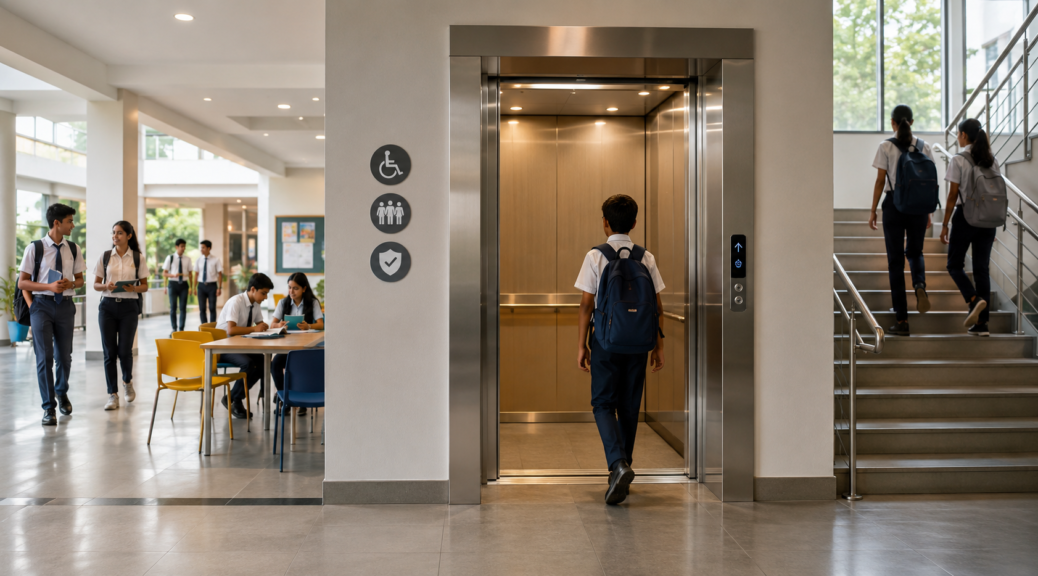
Elevator Selection for Schools, Colleges and Educational Buildings: Key Planning Factors
Elevator planning in a school or college isn’t the same as planning one for an office or residential building. Students move in groups, class schedules create sudden traffic peaks, and accessibility needs have to be considered from the beginning. The elevator may also need to accommodate teachers, staff, visitors, maintenance teams, and equipment.
For educational institutions, choosing the right elevator means looking beyond cabin size and speed. Building layout, student population, accessibility, operating frequency, safety, and future expansion all play a role. Working with an experienced passenger lift manufacturer can help schools and colleges select an elevator system that fits the way their buildings are actually used.
This guide explains the key factors educational institutions should consider before selecting and installing an elevator.
Table of Contents
Why Elevator Planning Matters in Educational Buildings
A school or college can have a very different traffic pattern from a commercial office.
Students may move between floors at the beginning and end of classes. Hundreds of students can leave classrooms within a few minutes, creating sudden demand for vertical transportation.
At other times, elevator usage may be relatively low.
This makes traffic planning important.
The elevator system should support daily movement without creating unnecessary waiting times or becoming overloaded during busy periods.
Understand How Students Use the Building
Before choosing an elevator, understand the building’s daily routine.
Ask:
- How many students use the building?
- How many floors require elevator access?
- How many classrooms are on each floor?
- Are laboratories or libraries located on upper floors?
- How many teachers and staff use the building?
- Are there large events or assemblies?
- Will visitors regularly use the elevator?
These answers provide a better picture of actual elevator demand.
A residential lift manufacturer would approach a school project differently from a commercial or institutional elevator specialist because the usage pattern is different.
Assess Student and Staff Traffic
Student movement often happens in waves.
For example, students may move from classrooms to laboratories between periods. At lunchtime, large groups may move toward common areas. At the end of the day, another traffic peak can occur.
The elevator doesn’t necessarily need to carry every student.
Stairs may handle much of the daily movement in low- and mid-rise buildings. However, the elevator remains important for accessibility, staff movement, visitors, and people who cannot comfortably use stairs.
For larger colleges and universities, passenger traffic analysis becomes even more important.
Choose the Right Elevator Capacity
Capacity should reflect the building’s actual requirements.
A school serving a few hundred students may have different needs from a large university campus with several academic blocks.
The planning team should consider:
- Student population
- Staff population
- Number of floors
- Cabin size
- Expected peak usage
- Accessibility requirements
- Equipment and material movement
A professional passenger lift manufacturer can help evaluate these factors and recommend an appropriate capacity.
Choosing a larger cabin isn’t automatically better. The goal is to select a capacity that works efficiently within the building’s usage pattern.
Consider Accessibility From the Start
Accessibility should be part of the building plan from the beginning.
Students, teachers, staff, and visitors may have mobility challenges and need reliable access to every required floor.
The elevator should therefore be planned around appropriate accessibility requirements, including:
- Suitable door width
- Accessible controls
- Adequate cabin space
- Clear entrance area
- Appropriate floor indications
- Emergency communication
The exact requirements depend on the building type, applicable regulations, and project design.
An accessible elevator isn’t simply a compliance requirement. It helps create a more inclusive educational environment.
Elevator Safety in Schools and Colleges
Educational buildings can have a large number of young users.
That makes safety particularly important.
The elevator system should include appropriate safety features and be installed according to applicable standards and regulations.
Depending on the elevator type, safety provisions may include:
- Door safety sensors
- Overload protection
- Emergency alarm
- Emergency lighting
- Door interlocks
- Emergency communication
- Automatic rescue systems
Schools should also establish clear procedures for elevator use and emergency situations.
Regular maintenance and inspections are equally important.
Selecting the Right Elevator Door Configuration
Door design affects accessibility and passenger flow.
Centre-opening automatic doors can provide a convenient entrance for passenger elevators. Other configurations, such as telescopic or side-opening doors, may be appropriate where space is limited or the building has specific requirements.
For educational buildings, consider:
- Available landing space
- Required door width
- Student traffic
- Accessibility
- Cabin dimensions
- Maintenance requirements
Door configuration should be finalized during the planning stage so that the architectural and structural requirements can be coordinated properly.
Passenger vs Service Elevators
Not every elevator in an educational campus needs to serve the same purpose.
A passenger elevator may handle students, teachers, staff, and visitors.
A separate service elevator can be useful for:
- Laboratory equipment
- Maintenance materials
- Furniture
- Cleaning equipment
- Supplies
- Food service
This can prevent service activity from interfering with normal student movement.
Large universities, boarding schools, and institutions with extensive facilities may particularly benefit from separating passenger and service transportation.
Elevator Planning for Multi-Storey Campuses
Large educational campuses often contain multiple buildings.
Instead of treating the campus as one project, planners should assess each building according to its individual function.
An academic block may have different elevator requirements from:
- Library buildings
- Hostels
- Administration blocks
- Laboratories
- Auditoriums
- Sports facilities
- Medical centers
For example, a science building may need to accommodate heavy laboratory equipment, while a hostel primarily needs passenger transportation.
The elevator specification should match the building’s function.
Consider Future Expansion
Educational institutions often expand over time.
New classrooms may be added. Student populations may increase. Existing spaces may change from one function to another.
Therefore, elevator planning should consider future requirements where practical.
This may involve providing appropriate shaft space, electrical provisions, structural allowances, or capacity planning for expected changes.
A little planning today can make future modifications much easier.
Shaft and Installation Requirements
Elevator installation requires coordination with the building’s architectural and structural design.
Important considerations include:
- Shaft dimensions
- Pit depth
- Headroom
- Landing openings
- Structural supports
- Machine room requirements, where applicable
- Electrical supply
- Access for installation and maintenance
These requirements should be finalized before construction reaches the relevant stage.
Late changes can lead to unnecessary civil work and project delays.
Maintenance and Reliability
Schools and colleges depend on reliable building services.
An elevator that repeatedly stops working can become a major inconvenience, particularly for students or staff who depend on it for accessibility.
Regular preventive maintenance helps identify issues before they become larger problems.
Educational institutions should ask potential elevator suppliers about:
- Preventive maintenance
- Emergency service
- Spare parts availability
- Service response
- Warranty
- AMC options
- Inspection procedures
Choosing an experienced elevator company with dependable after-sales support can make a significant difference over the elevator’s operational life.
Common Elevator Planning Mistakes
Planning Only for Current Student Numbers
Enrollment can change over time. Future requirements should be considered.
Ignoring Accessibility
Accessibility should be part of the original design rather than added later.
Focusing Only on Elevator Capacity
Capacity is important, but speed, traffic patterns, door configuration, and building layout matter too.
Forgetting Service Movement
Laboratories, kitchens, maintenance departments, and storage areas may need separate service transportation.
Selecting Equipment Too Late
Late elevator decisions can create problems with shafts, pits, electrical provisions, and structural requirements.
Choosing Only on Initial Cost
An elevator is a long-term building asset. Reliability, maintenance, energy consumption, warranty, and service support should also be evaluated.
Choosing the Right Elevator Partner
Educational institutions need an elevator partner that understands both technical requirements and the realities of high-traffic public buildings.
When evaluating a lift manufacturer, schools and colleges should look at:
- Relevant institutional experience
- Elevator specifications
- Safety features
- Accessibility capabilities
- Installation expertise
- Testing and commissioning
- Maintenance support
- Spare parts availability
- After-sales service
At Spire Elevators, we work with builders, architects, educational institutions, and project teams to develop elevator solutions suited to the building’s actual requirements. From passenger lifts to service and specialized applications, our team supports the project through planning, installation, testing, and ongoing maintenance.
The right elevator for a school or college isn’t simply the fastest or largest model.
It’s the one that provides safe, accessible, reliable vertical transportation for the people who use the building every day.
Frequently Asked Questions
1. Do schools need elevators?
Elevator requirements depend on the building design, number of floors, accessibility needs, applicable regulations, and how the facility is used. Multi-storey educational buildings should assess vertical accessibility during the planning stage.
2. What type of elevator is suitable for a school?
A passenger elevator designed around the school’s occupancy, accessibility requirements, building height, and expected traffic is generally considered. The appropriate specification should be determined through project-specific assessment.
3. How much elevator capacity does a college need?
There is no fixed capacity for every college. Student population, staff numbers, floor usage, peak traffic, cabin dimensions, and accessibility requirements should all be considered.
4. Should schools have separate service elevators?
Large institutions may benefit from dedicated service elevators for laboratory equipment, supplies, maintenance materials, furniture, or food-service operations. The need depends on the campus layout and operational requirements.
5. How important is elevator maintenance in educational buildings?
Regular maintenance is essential. Educational buildings have frequent daily use, so preventive servicing helps maintain reliable operation and identify potential problems early.
6. When should elevator planning begin for a new school building?
Elevator planning should begin during the architectural and structural design stage. Early coordination helps finalize shaft dimensions, pit requirements, electrical provisions, accessibility, and installation requirements before construction progresses.
7. How can an educational institution choose the right elevator company?
Look for an experienced passenger lift manufacturer or elevator company with institutional project experience, strong safety practices, professional installation, testing and commissioning capabilities, and dependable after-sales support.