
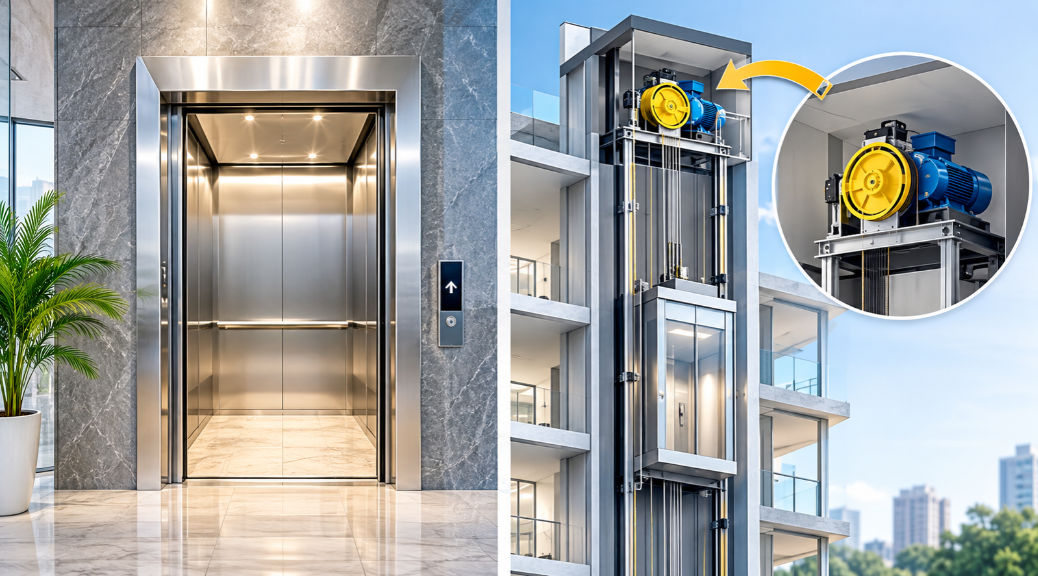
What Is an MRL Elevator and Where Does the Machine Go?
Modern buildings require elevator systems that use available space efficiently without compromising passenger comfort, safety or performance. Traditionally, elevators needed a separate machine room to accommodate the motor, control equipment and other operating components. However, advancements in elevator engineering have introduced a more compact alternative: the MRL elevator.
A Machine Room-Less (MRL) elevator is designed without a conventional, separate machine room. Instead, its machinery is integrated into the elevator shaft or hoistway, depending on the system’s design.
But this raises an important question for homeowners, architects, builders and commercial property developers: If an MRL elevator does not have a machine room, where does its motor actually go?
In this guide, we explain what an MRL elevator is, where its machine and controller are positioned, how the system works, and what building owners should consider before planning an installation.
Table of Contents
What Is an MRL Elevator?
An MRL elevator, also known as a machine room less elevator or MRL lift, is a traction-based elevator system that does not require a separate machine room above or below the lift shaft.
In a conventional machine-room elevator, the traction machine and associated equipment are generally installed in a dedicated room, often above the hoistway. An MRL system removes the need for this separate space by integrating the main machinery into the hoistway arrangement.
Most modern MRL traction systems use compact machines, often gearless, along with an elevator controller and other supporting components.
The basic working concept remains similar to a conventional traction elevator:
- An electric motor drives a traction sheave.
- Suspension ropes or belts connect the elevator car and counterweight.
- The counterweight balances part of the car load.
- The controller manages movement, speed, stopping and door operation.
The key difference is the equipment arrangement. In an MRL elevator system, the machinery is accommodated within the lift shaft or in designated locations specified by the manufacturer.
MRL elevators are commonly considered for residential apartments, independent buildings, offices, hotels and other projects where a separate machine room may be difficult to accommodate.
Where Does the Machine Go in an MRL Elevator?
This is the most important difference between a conventional elevator and a machine room less lift.
An MRL elevator does not eliminate the machinery. It changes where the machinery is installed.
In many MRL traction elevator designs, the traction machine is positioned inside the hoistway, commonly near the top of the shaft. This arrangement allows the elevator to operate without requiring a separate machine room on the rooftop.
However, the exact position depends on the manufacturer’s design, the elevator configuration, the available shaft dimensions and the applicable installation requirements.
Machine Location Inside the Lift Shaft
The traction machine is generally one of the main components integrated into the elevator hoistway.
In many conventional MRL traction configurations, the machine is installed near the upper section of the shaft, where it can drive the suspension ropes or belts through the traction sheave.
The machine is securely supported by a manufacturer-designed structural arrangement. Its position is planned in relation to the elevator car, counterweight, guide rails and suspension system.
This layout helps avoid the need for a separate machine room while keeping the major mechanical components within the elevator’s designated space.
Important: Not every MRL elevator machine location is identical. Some systems use different machine positions or arrangements. The approved manufacturer’s drawings should always be used to understand the exact configuration.
Where Are the Controller and Other Components Located?
The traction machine is not the only component that needs space in an MRL system. The elevator also requires electrical and control equipment to operate safely.
Depending on the design, these components may be installed within the hoistway or in designated accessible locations near the elevator landing.
Common components include:
- Elevator Controller
The controller is the operating intelligence of the elevator. It processes commands from landing buttons, cabin controls, sensors and other safety devices to manage elevator movement.
In MRL systems, the controller may be placed in a designated control cabinet near a landing or in another manufacturer-approved location.
- Drive System
The drive system regulates the motor’s operation, including acceleration, deceleration and stopping. It works with the controller to provide controlled elevator movement.
- Electrical Panels
Electrical panels contain the necessary electrical connections, protection devices and supporting equipment. Their arrangement depends on the elevator design and installation requirements.
- Safety and Monitoring Components
Door interlocks, sensors, emergency rescue arrangements and other safety-related equipment work together to monitor elevator operation and respond to abnormal conditions.
The important point is that MRL elevator technology uses a carefully planned equipment arrangement rather than simply placing every component in one separate room.
How Is the Machine Accessed for Maintenance?
One common concern about an MRL lift is maintenance access.
Since the traction machine is installed within the hoistway in many designs, technicians cannot simply enter a traditional machine room to inspect it.
Instead, access is provided through manufacturer-designed maintenance arrangements, which may include designated service panels, access points and approved procedures.
Maintenance planning must account for:
- Safe access to the traction machine and associated equipment.
- Adequate working clearances for inspection and servicing.
- Access to the controller and electrical components.
- Safe isolation of electrical power before relevant work.
- Approved procedures for inspection, testing and emergency operations.
Only trained and authorised elevator technicians should access or work on these components. Maintenance must follow the manufacturer’s instructions and applicable safety requirements.
Therefore, an MRL system may save the need for a separate machine room, but it still requires properly planned and safe maintenance access.
How Does an MRL Elevator Work?
An MRL traction elevator works through the coordinated operation of mechanical, electrical and control components.
Although the machinery is arranged differently from a traditional machine-room elevator, the basic traction principle remains similar.
Here is how the major components work together.
- Traction Machine
The traction machine supplies the mechanical power required to move the elevator car.
In many modern MRL systems, a compact gearless traction machine is used. Its position is integrated into the hoistway arrangement, reducing the need for a separate machine room.
The machine operates in response to signals from the elevator controller.
- Motor and Sheave
The electric motor rotates the traction sheave, which is the grooved wheel that engages with the suspension ropes or belts.
As the sheave rotates, it moves the suspension system in the required direction.
The motor’s speed and torque are controlled to support smooth starting, travelling and stopping.
- Suspension Ropes or Belts
Suspension ropes or belts connect the elevator car and counterweight through the traction arrangement.
When the traction machine rotates the sheave, the ropes or belts move, allowing the elevator car to travel upward or downward.
The type of suspension arrangement depends on the elevator model and manufacturer.
- Counterweight
The counterweight balances a substantial portion of the elevator car’s weight and its load.
It helps reduce the effort required from the traction machine during operation.
The counterweight moves in the opposite direction to the elevator car. Its size and configuration are determined by the elevator’s engineering design.
- Elevator Controller
The elevator controller manages the complete operating sequence.
It receives information from the cabin buttons, landing controls, sensors and safety devices. It then coordinates the motor, drive system, braking and door operation.
For example, when a passenger selects a floor, the controller processes the request and manages the elevator’s movement and stopping sequence.
Together, these components make an MRL elevator system capable of providing controlled vertical transportation without a conventional separate machine room.
Key Benefits of MRL Elevators
The main advantage of a machine room less elevator is its equipment arrangement. By integrating the machinery into the hoistway, it can provide greater flexibility during building planning.
Some important benefits include:
No Separate Machine Room Required
An MRL lift does not require a conventional, dedicated machine room for its main traction machinery.
This can simplify rooftop planning and reduce the need to allocate additional building space for a separate equipment room.
Better Use of Building Space
Removing the separate machine room can help architects and developers plan the available building area more efficiently.
This can be particularly useful in projects where rooftop space or additional construction area is limited.
Flexible Building Planning
An MRL elevator can be considered during the early design stage of residential and commercial projects.
Its equipment arrangement may provide greater flexibility when coordinating the elevator shaft with the building’s overall layout.
Suitable for Many Modern Residential Projects
MRL systems are used in a range of residential applications, including apartment buildings and other projects where space efficiency is important.
The final suitability depends on the building’s height, capacity, usage and structural requirements.
Compact Equipment Arrangement
Modern traction machines and integrated control arrangements allow major elevator components to be accommodated without a conventional separate machine room.
Potential Energy-Efficiency Benefits
Many MRL systems use modern traction technology and variable-frequency drives to control motor operation.
Depending on the selected equipment, building usage and operating conditions, these features may contribute to efficient energy consumption.
However, actual energy performance should be assessed using the specifications of the proposed elevator system rather than assuming that every MRL model offers the same savings.
MRL Elevator vs Traditional Machine Room Elevator
Both MRL and conventional machine-room elevators can provide reliable vertical transportation. The main difference lies in their machinery arrangement and building space requirements.
| Comparison Factor | MRL Elevator | Machine Room Elevator |
| Machine room | Separate machine room not required | Dedicated machine room generally required |
| Machine location | Integrated into the hoistway in many designs | Usually installed in a dedicated machine room |
| Space planning | Can offer more flexibility | Requires additional space for the machine room |
| Maintenance access | Depends on the manufacturer’s access arrangement | Equipment is generally accessed through the machine room |
| Installation planning | Requires careful hoistway and equipment coordination | Requires machine-room and shaft planning |
| Applications | Residential and commercial projects, depending on specifications | Residential, commercial and other applications |
Neither configuration is automatically better for every building.
An MRL elevator may be suitable when a separate machine room is difficult to accommodate. A conventional machine-room system may be more appropriate for certain building configurations or operational requirements.
The right choice depends on the project design, building height, traffic requirements, available space, equipment specifications and maintenance arrangements.
Where Are MRL Elevators Commonly Used?
A machine room less lift can be considered for different types of buildings where its technical specifications match the project’s requirements.
Residential Buildings
Residential apartments and multi-storey housing projects often require elevators that balance passenger comfort, efficient space utilisation and reliable daily operation.
An MRL system can be considered where the building layout does not allow for a separate machine room or where a more integrated arrangement is preferred.
Independent Houses and Villas
Some independent homes and villas require a compact elevator arrangement to improve accessibility between floors.
A residential MRL elevator may be considered where the available shaft dimensions, travel height and structural conditions support the proposed system.
Commercial Buildings
Office buildings and commercial properties require elevators capable of handling regular passenger movement.
An MRL system may be suitable for certain commercial projects, depending on passenger capacity, traffic intensity, speed and building height.
Hotels and Hospitality Properties
Hotels need dependable vertical transportation for guests, staff and service operations.
MRL elevators may be considered for selected hospitality projects where the proposed capacity, speed and operating requirements match the building’s needs.
Mid-Rise Buildings
MRL technology is commonly considered for low- to mid-rise developments.
However, the suitable travel height and speed are not universal. They depend on the specific elevator model, manufacturer specifications and applicable requirements.
Important Factors to Consider Before Installing an MRL Elevator
Selecting an MRL elevator involves more than checking whether the building has enough space for a lift shaft.
The equipment must be compatible with the building’s structure, passenger requirements and long-term maintenance needs.
Before planning an MRL elevator installation, consider the following factors:
- Available Shaft Dimensions
The shaft’s width, depth and overall configuration must accommodate the elevator car, guide rails, counterweight, machinery and other required components.
- Building Height
The number of floors and total travel distance influence the selection of the elevator system.
The proposed MRL model must be suitable for the building’s required travel height and operating conditions.
- Passenger Capacity
The rated capacity should be selected according to the expected number of passengers and the building’s usage pattern.
A private residence, apartment building and commercial office will have different passenger movement requirements.
- Rated Speed
Elevator speed should be selected according to the number of floors, travel distance and expected passenger traffic.
- Headroom and Pit Requirements
Headroom refers to the available vertical space above the top landing, while the pit is the space below the lowest landing.
Both dimensions must comply with the requirements of the selected elevator design.
- Electrical Requirements
The building must provide the electrical supply and supporting arrangements specified by the elevator manufacturer.
Backup and emergency rescue arrangements should also be considered during planning.
- Maintenance Access
Although a separate machine room is not required, the machine, controller and other serviceable components must remain accessible through the approved maintenance arrangement.
- Applicable Safety Standards
The elevator should be designed, installed, inspected and maintained in accordance with applicable local regulations, relevant safety standards and manufacturer instructions.
A technical site assessment before installation helps identify potential design or construction issues early.
Common Misconceptions About MRL Elevators
MRL elevators are often described as space-saving systems, but some assumptions about their design can lead to confusion.
Let’s clarify a few common misconceptions.
Misconception 1: MRL Elevators Have No Machinery
Reality: An MRL elevator still has a traction machine, motor, controller, drive system and other essential components.
The difference is that the equipment is integrated into the hoistway arrangement instead of being housed in a conventional separate machine room.
Misconception 2: All MRL Elevators Have the Same Machine Location
Reality: Machine placement varies according to the manufacturer and system design.
While many MRL traction elevators position the machine near the top of the hoistway, other configurations may differ.
Always refer to the approved equipment drawings for the exact arrangement.
Misconception 3: MRL Elevators Require No Maintenance
Reality: Every elevator requires regular inspection and maintenance.
MRL systems also need checks of their traction machinery, suspension components, braking arrangements, electrical systems, doors and safety devices.
Maintenance must be performed by qualified technicians following the manufacturer’s recommendations.
Misconception 4: MRL Elevators Are Suitable for Every Building
Reality: An MRL system may not be appropriate for every project.
Building height, shaft dimensions, passenger traffic, capacity, speed and structural conditions all influence elevator selection.
A site assessment is necessary before finalising the system.
Misconception 5: No Machine Room Means No Additional Space Requirements
Reality: Although a separate machine room is not required, the elevator still needs adequate space for its shaft, car, counterweight, traction machine, controller arrangement and maintenance access.
The building must meet all specified pit, headroom and clearance requirements.
Why Choose Spire Elevators for MRL Lift Solutions?
Choosing an elevator is a long-term building decision. The right solution should account for the building’s structural design, passenger requirements, equipment configuration, installation and ongoing maintenance.
Spire Elevators provides elevator manufacturing, installation, customisation and maintenance services for residential and commercial projects.
Its Machine Room Less elevator solutions are designed around space-efficient equipment arrangements and modern traction technology.
When evaluating an MRL system, project owners can discuss important requirements such as:
- Building structure and available shaft dimensions.
- Required passenger capacity and travel height.
- Elevator configuration and equipment placement.
- Installation planning and technical coordination.
- Maintenance access and after-sales support.
Spire also provides elevator installation services, technical support, repairs, upgrades and maintenance programmes.
With its experience in elevator manufacturing and project execution, the company works with customers to identify elevator solutions suited to their building requirements.
If you are planning a residential or commercial elevator project, visit Spire Elevators to explore its solutions or contact the team for an MRL elevator enquiry.
Frequently Asked Questions
- What does MRL stand for in elevators?
MRL stands for Machine Room-Less. An MRL elevator is designed without a conventional separate machine room, with its machinery integrated into the elevator hoistway arrangement.
- Where is the motor located in an MRL elevator?
In many MRL traction elevator designs, the motor and traction machine are installed inside the lift shaft, commonly near its upper section. The exact position depends on the manufacturer’s design and equipment configuration.
- Does an MRL elevator need a machine room?
No. An MRL elevator does not require a conventional separate machine room. However, it still needs designated space within the hoistway and approved locations for its machinery, controller and other components.
- Is an MRL elevator suitable for residential buildings?
Yes. An MRL elevator for residential buildings can be suitable for apartments and certain independent residential projects. Its suitability depends on building height, shaft dimensions, passenger capacity and other technical requirements.
- What is the difference between an MRL and a traditional elevator?
The primary difference is the location of the machinery. An MRL elevator integrates its machinery into the hoistway arrangement, while a traditional machine-room elevator generally uses a separate room to house its main equipment.
- Are MRL elevators easy to maintain?
MRL elevators can be maintained effectively when designed with suitable service access and maintained by qualified technicians. Since the machinery may be located within the hoistway, maintenance requires manufacturer-approved access arrangements and procedures.
- Do MRL elevators require special shaft dimensions?
Yes. MRL elevators have specific shaft, pit, headroom and clearance requirements. These vary according to the elevator model, rated capacity, speed and equipment configuration. The manufacturer should provide approved drawings before construction or installation.
Conclusion
An MRL elevator offers a different approach to elevator machinery placement. Instead of using a conventional separate machine room, it integrates the traction machine and associated equipment into the hoistway arrangement.
For building owners, architects and developers, understanding where the machine, controller and other components are located is essential before selecting this type of lift.
Although MRL technology can improve space utilisation and provide greater flexibility in building planning, it still requires appropriate shaft dimensions, safe maintenance access and careful engineering.
The best way to determine whether a machine room less elevator is suitable for your project is to evaluate the building structure, passenger requirements and equipment specifications with an experienced elevator manufacturer.
Planning an MRL elevator for your building? Connect with Spire Elevators to discuss your project requirements and explore a suitable lift solution.