
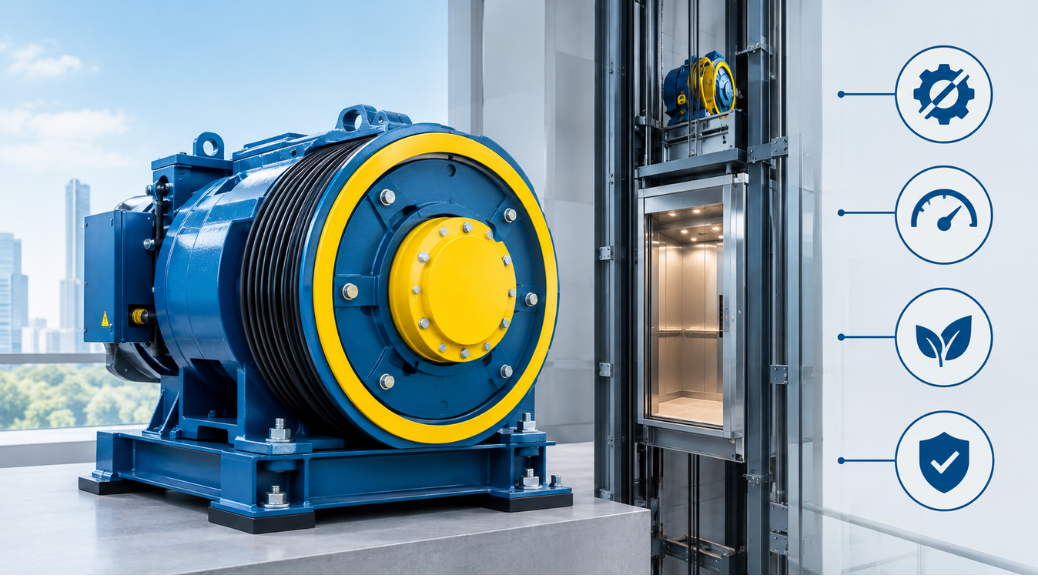
Gearless Elevator Machines: Benefits, Applications and How They Work
Elevator technology has evolved significantly to meet the demands of modern high-rise buildings, commercial towers and high-traffic properties. Among the different traction technologies available today, the gearless elevator machine is widely associated with applications where higher speeds, efficient operation and reliable vertical transportation are important.
Gearless traction systems are commonly considered for high-rise buildings, commercial towers, hotels, hospitals, shopping centres and other buildings where elevators may operate frequently and travel over greater distances.
But what exactly is a gearless elevator machine, how does it work, and how does it differ from a geared system?
Understanding the technology can help architects, builders, developers and facility managers make more informed decisions when planning an elevator system.
Table of Contents
What Is a Gearless Elevator Machine?
A gearless elevator machine is a traction machine in which the motor drives the elevator’s traction sheave directly, without using a separate gear reduction system.
In a traditional geared elevator, the motor drives a gearbox, which then transfers rotational movement to the traction sheave.
In a gearless system, the motor and traction sheave are directly connected.
This direct-drive arrangement eliminates the need for a gearbox between the motor and traction sheave.
Gearless vs Geared Traction
The fundamental difference is the method used to transfer motor power to the traction sheave.
Geared system:
Motor → Gearbox → Traction Sheave → Elevator Ropes
Gearless system:
Motor → Traction Sheave → Elevator Ropes
The gearless configuration can provide advantages in applications requiring higher speeds and longer travel distances.
However, this does not mean that gearless technology is automatically the best option for every building.
The appropriate elevator system depends on factors such as:
- Building height
- Required speed
- Passenger capacity
- Traffic volume
- Shaft configuration
- Machine-room arrangement
- Energy requirements
- Budget
- Maintenance considerations
How Does a Gearless Elevator Machine Work?
A gearless traction elevator uses the principle of traction to move the elevator car.
The basic working process can be explained in several steps.
1. Electrical Power Reaches the Motor
When the elevator receives a movement command, the elevator controller sends the appropriate electrical power to the traction motor.
The controller regulates the motor’s operation according to the required direction, speed and movement profile.
2. The Motor Rotates the Traction Sheave
In a gearless system, the motor is directly connected to the traction sheave.
The motor’s rotation therefore turns the sheave without requiring a gearbox.
3. The Traction Sheave Moves the Ropes
Elevator suspension ropes pass around the traction sheave.
The friction between the ropes and sheave allows the rotational movement of the sheave to move the ropes.
4. The Elevator Car and Counterweight Move
The ropes connect the elevator car and counterweight.
As the traction sheave rotates, the elevator car moves upward or downward while the counterweight moves in the opposite direction.
The counterweight helps balance the elevator system and reduces the amount of motor power required to move the car under normal operating conditions.
5. The Brake Controls Stopping and Holding
A braking system is used to stop and hold the elevator when it reaches the required floor.
The brake is an important part of the elevator’s safety and control system.
6. The Controller Manages Movement
Modern elevator controllers coordinate acceleration, speed, deceleration and stopping.
An encoder or similar feedback device can provide information about motor position and movement, allowing the control system to accurately regulate the elevator.
The result is controlled movement from one floor to another.
Main Components of a Gearless Elevator System
A gearless elevator is not simply a motor.
It is an integrated system consisting of several mechanical, electrical and control components.
Gearless Traction Motor
The traction motor provides the rotational force required to move the elevator.
Because the motor directly drives the traction sheave, there is no intermediate gearbox.
Traction Sheave
The traction sheave transfers the motor’s rotational movement to the suspension ropes.
Its design and compatibility with the ropes are important for reliable traction.
Suspension Ropes
The ropes support and move the elevator car and counterweight.
Their specifications depend on factors such as load, elevator configuration and system design.
Counterweight
The counterweight balances the elevator car and a portion of its rated load.
This helps reduce the amount of energy required by the traction system.
Brake System
The brake helps bring the elevator to a controlled stop and hold it at the required position.
Controller
The controller manages the elevator’s movement.
It coordinates functions such as:
- Starting
- Acceleration
- Speed control
- Deceleration
- Floor stopping
- Door operation
- Safety-related responses
Encoder
An encoder provides position or speed feedback to the control system.
This helps the controller accurately manage motor movement and elevator positioning.
Elevator Car
The elevator car is the passenger or load-carrying enclosure that travels between floors.
Its dimensions and rated capacity depend on the intended application.
Guide Rails
Guide rails guide the elevator car and counterweight vertically through the shaft.
They help maintain controlled movement throughout the elevator’s travel.
Benefits of Gearless Elevator Machines
Gearless traction technology can provide several advantages when appropriately specified for a building.
High-Speed Performance
One of the main reasons gearless traction technology is associated with high-rise applications is its ability to support higher elevator speeds.
In a tall building, passengers may need to travel many floors within a relatively short period.
Higher-speed elevator systems can therefore help reduce travel time and improve vertical transportation efficiency.
The actual speed should always be selected according to the building’s height, traffic pattern, elevator design and applicable requirements.
Better Energy Efficiency
A gearless elevator uses direct traction rather than transferring motor power through a gearbox.
This can reduce mechanical transmission losses associated with the gear reduction stage.
Energy efficiency also depends on many other factors, including:
- Motor technology
- Elevator load
- Traffic pattern
- Drive system
- Counterweight configuration
- Control system
- Regenerative technology
- Building usage
Therefore, gearless does not automatically mean that every system will consume less energy in every application.
Smooth and Comfortable Ride
Modern gearless elevator systems can provide controlled acceleration, travel and deceleration.
Electronic speed control allows the elevator system to manage movement more precisely.
This can contribute to:
- Smooth acceleration
- Controlled deceleration
- Accurate floor stopping
- Improved passenger comfort
Actual ride quality depends on the complete elevator system—not just the traction machine.
Lower Mechanical Complexity
Because a gearless elevator does not require a separate gearbox, it has fewer mechanical transmission components between the motor and traction sheave.
This can simplify the drive arrangement and eliminate gearbox-related mechanical components.
However, the complete elevator system still contains many components that require professional inspection and maintenance.
Suitable for High-Rise Buildings
Gearless traction systems are commonly associated with high-rise and high-speed elevator applications.
As building height increases, the required travel distance and transportation performance become more important.
Gearless traction technology can therefore be considered for:
- High-rise residential towers
- Commercial towers
- Corporate buildings
- Hotels
- Mixed-use developments
- High-traffic properties
The final selection should always be based on an engineering assessment.
Long-Term Performance
A properly designed and maintained gearless elevator system can support frequent elevator operation over an extended service life.
However, long-term performance depends on more than the traction machine.
It also depends on:
- Installation quality
- Correct system design
- Preventive maintenance
- Operating conditions
- Component quality
- Regular inspections
- Timely replacement of worn components
Where Are Gearless Elevators Used?
Gearless elevator technology can be considered for buildings where speed, travel distance and traffic handling are important.
High-Rise Residential Buildings
Tall residential towers may require elevators capable of travelling between many floors efficiently.
Gearless traction systems can be considered where the required speed and building configuration make them appropriate.
Commercial Towers
Corporate offices and commercial buildings can experience significant passenger traffic, particularly during peak hours.
Elevator planning in these buildings needs to consider traffic patterns and transportation capacity.
Hotels
Hotels require reliable passenger transportation throughout the day.
Elevator selection may need to consider guest movement, staff operations, luggage and service requirements.
Hospitals
Hospitals have specialised transportation requirements.
Passenger and hospital elevator systems may need to accommodate patients, attendants, medical equipment and hospital staff.
The elevator technology should therefore be selected based on the facility’s specific operational needs.
Shopping Malls
Shopping centres can experience high passenger traffic, especially during weekends and peak periods.
Elevator capacity, speed, traffic management and reliability can all become important considerations.
Mixed-Use Developments
Modern developments may combine:
- Residential towers
- Offices
- Retail
- Hotels
- Parking facilities
Different areas of the same development may require different elevator solutions.
Gearless vs Geared Elevator Machines
Both technologies have applications in the elevator industry.
The right choice depends on the building and operating requirements.
| Factor | Gearless | Geared |
| Drive mechanism | Direct traction | Gearbox-based traction |
| Typical application | High-rise/high-speed applications | Low to medium-rise applications and other suitable uses |
| Speed capability | Generally suitable for higher speeds | Generally suited to lower speeds |
| Mechanical transmission | No separate gearbox | Uses gearbox |
| Energy efficiency | Can offer efficiency advantages depending on system | Mechanical gearing introduces transmission losses |
| Ride performance | Can provide smooth performance with appropriate controls | Depends on overall system design |
| Initial investment | Often higher | Often lower |
| Maintenance | No gearbox to maintain, but other components require servicing | Includes gearbox-related maintenance |
This table should not be interpreted as meaning that gearless elevators are always superior.
A geared elevator can be an appropriate and cost-effective solution for certain buildings.
Similarly, a gearless elevator may be unnecessary for a building where high speed or long travel is not required.
Factors to Consider Before Choosing a Gearless Elevator Machine
Before selecting a gearless elevator machine, businesses, developers and architects should evaluate the complete building requirement.
Building Height
The number of floors and total travel distance can influence the suitability of gearless traction technology.
Required Elevator Speed
Determine the speed required based on:
- Building height
- Passenger traffic
- Expected travel time
- Number of floors
- Peak-hour requirements
Passenger Capacity
The elevator’s rated load should match the expected passenger demand.
A high-traffic commercial building may have very different capacity requirements from a private residential property.
Traffic Volume
Peak-hour traffic should be considered rather than relying only on average daily usage.
For commercial buildings, elevator planning may need to account for:
- Morning arrivals
- Lunch-hour movement
- Evening departures
- Visitor traffic
- Service movement
Shaft Dimensions
Available shaft space can influence the elevator configuration.
Consider:
- Shaft width
- Shaft depth
- Pit depth
- Headroom
- Door opening
- Machine arrangement
Machine-Room Configuration
The building design should be evaluated to determine the appropriate machine arrangement.
Depending on the system, machine-room and equipment-space requirements can vary.
Energy Requirements
Businesses should consider both initial specifications and long-term operating costs.
Energy consumption can be affected by:
- Elevator traffic
- Motor technology
- Control system
- Counterweighting
- Travel distance
- Load
- Standby operation
Installation Requirements
A professional site assessment should be completed before finalising the machine.
Installation planning should consider:
- Structural requirements
- Electrical supply
- Shaft dimensions
- Machine installation
- Control equipment
- Testing and commissioning
Maintenance Support
Ask the manufacturer or supplier about:
- Preventive maintenance
- Spare parts
- Technical support
- Breakdown service
- AMC options
- Modernization support
Total Lifecycle Cost
The cheapest machine is not necessarily the most economical option over its operating life.
Consider:
Purchase + Installation + Energy + Maintenance + Spare Parts + Downtime
This provides a more realistic picture of the elevator’s total cost.
Is a Gearless Elevator Better Than a Geared Elevator?
Not necessarily.
The better technology depends on the building.
Gearless elevators can be advantageous when the project requires:
- Higher speed
- Longer travel
- High-rise transportation
- Frequent operation
- Smooth performance
- Efficient direct-drive traction
Geared systems can remain suitable for applications where extremely high speed or long travel is not required.
The decision should therefore be based on engineering requirements rather than the assumption that one technology is universally better.
Are Gearless Elevators Suitable for High-Rise Buildings?
Yes, gearless traction technology is commonly considered for high-rise buildings because it can support higher-speed elevator applications and longer travel distances.
However, the complete elevator system must be engineered according to the building’s height, traffic demand, capacity, shaft design and other requirements.
Are Gearless Elevator Machines Energy Efficient?
Gearless systems can offer energy-efficiency advantages because they eliminate the mechanical transmission losses associated with a gearbox.
However, actual energy consumption depends on the complete elevator system.
Factors such as motor technology, drive controls, traffic, load, counterweighting and regenerative systems can all influence energy performance.
How Does a Gearless Traction Machine Work?
A gearless traction machine directly rotates the elevator’s traction sheave.
The sheave moves the suspension ropes, which move the elevator car and counterweight.
The controller manages the motor’s speed and direction, while the braking system controls stopping and holding.
This direct-drive arrangement eliminates the need for a separate gearbox.
Where Are Gearless Elevators Commonly Used?
Gearless elevators are commonly considered for:
- High-rise residential buildings
- Commercial towers
- Corporate offices
- Hotels
- Hospitals
- Shopping malls
- Mixed-use developments
- Other high-traffic or high-speed applications
The exact elevator technology should be selected according to the project’s engineering requirements.
Why Choose the Right Elevator Machine Manufacturer?
Selecting the right machine or elevator manufacturer is as important as selecting the technology.
A reliable manufacturer should be able to provide support across the complete project lifecycle.
Engineering Expertise
The manufacturer should understand how the machine interacts with:
- Elevator controller
- Traction system
- Brake
- Ropes
- Counterweight
- Car
- Guide rails
- Building structure
Machine Quality
The traction machine is a critical component of the elevator system.
Its design, manufacturing quality and compatibility with the rest of the system should be carefully evaluated.
System Compatibility
A machine should not be selected in isolation.
It needs to be compatible with the complete elevator system and its operating requirements.
Installation Support
The manufacturer or supplier should be able to support proper installation, testing and commissioning.
Testing and Commissioning
Before the elevator enters service, appropriate testing and commissioning should be completed according to the applicable requirements.
Spare Parts
Ask about the availability of replacement components and technical support throughout the expected operating life.
Technical Support
Reliable technical assistance can help address operational issues and maintenance requirements.
Maintenance Services
A long-term maintenance programme can help identify wear and potential problems before they result in major downtime.
Why Choose Spire Elevators?
For a gearless elevator project, the machine should be evaluated as part of the complete elevator system rather than as an isolated component.
Spire Elevators is an elevator manufacturing and service company operating in the Delhi NCR region and provides elevator solutions for residential, commercial and other applications.
Its stated services include:
- Elevator manufacturing
- Installation
- Maintenance
- Repair
- Upgrades
- Modernization
- Technical services
Spire lists its manufacturing facility in Daulatabad Industrial Area, Gurgaon, providing a manufacturing presence in the NCR region.
For projects considering traction elevator technology, working with an elevator company capable of handling manufacturing, installation and ongoing maintenance can help ensure that the different parts of the elevator system are properly coordinated.
Rather than selecting a machine solely on specifications, project owners should discuss:
- Building height
- Required speed
- Passenger capacity
- Traffic requirements
- Shaft dimensions
- Machine arrangement
- Safety requirements
- Installation
- Maintenance
- Lifecycle cost
Spire’s broader elevator manufacturing, installation and modernization capabilities can provide a starting point for businesses and developers evaluating elevator solutions for their projects.
Conclusion
A gearless elevator machine can be an effective solution for buildings where high speed, long travel distances, frequent operation and efficient traction are important.
Its direct-drive design eliminates the need for a gearbox between the motor and traction sheave and can provide advantages in suitable high-rise and high-traffic applications.
However, choosing an elevator should never be based on technology alone.
Before selecting a gearless elevator system, evaluate:
Building height + Speed + Capacity + Traffic + Shaft Design + Safety + Installation + Maintenance + Lifecycle Cost
For developers, architects, builders and facility managers, the right approach is to first understand the building’s transportation requirements and then select the elevator technology that best meets those requirements.
If you are evaluating a gearless elevator machine manufactureror elevator system for a commercial or high-rise project, consult an experienced elevator company to assess the site and determine the appropriate configuration.
Frequently Asked Questions
What is a gearless elevator machine?
A gearless elevator machine is a traction machine in which the motor directly drives the traction sheave without using an intermediate gearbox.
What is the main advantage of a gearless elevator?
Gearless systems can be suitable for higher-speed and longer-travel applications and can eliminate gearbox-related mechanical transmission losses.
Is a gearless elevator suitable for high-rise buildings?
Yes. Gearless traction systems are commonly considered for high-rise buildings because they can support higher speeds and long travel distances.
What is the difference between a gearless and geared elevator?
A gearless elevator directly connects the motor to the traction sheave, while a geared elevator uses a gearbox between the motor and traction sheave.
Are gearless elevator machines more expensive?
Gearless systems often have a higher initial investment than comparable geared systems, although the overall economics depend on the building, equipment, energy consumption, maintenance and operating requirements.
Are gearless elevators energy efficient?
They can provide energy-efficiency advantages due to direct-drive operation, but actual energy consumption depends on the complete elevator system and how it is operated.
Where are gearless traction elevators used?
They are commonly considered for high-rise residential buildings, commercial towers, hotels, hospitals, shopping malls and other buildings requiring higher-speed or high-traffic elevator transportation.
Does a gearless elevator require maintenance?
Yes. Gearless does not mean maintenance-free. Brakes, ropes, sheaves, bearings, electrical components, controls and other elevator components require inspection and maintenance.
Should I choose gearless or geared technology?
The decision should be based on building height, speed, traffic, capacity, shaft configuration, budget, energy requirements and long-term operating costs.
How do I choose a gearless elevator machine manufacturer?
Evaluate the manufacturer’s engineering capability, product quality, system compatibility, installation expertise, testing and commissioning process, spare-parts availability, technical support and maintenance services.